Gemini 4 Argon vs Claude Opus 5.5 vs GPT-6 Astra: Which Is Worth Paying For?
Published
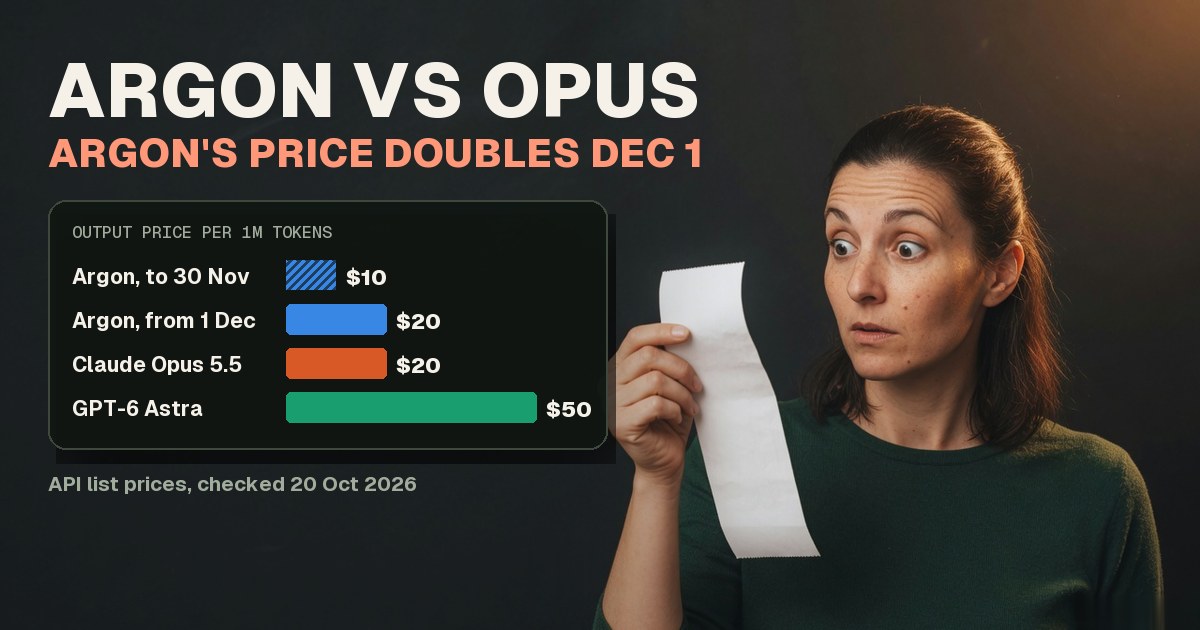
Pay for Claude Opus 5.5 if you write code or produce office documents. Pay for Gemini 4 Argon if you do legal or finance work, or run many jobs and care about cost. On the independent tests, Opus 5.5 scores a little higher than Argon. Argon gets most of the way there, often for about half the cost per task. GPT-6 Astra charges the most per token and trails Opus 5.5 on every independent test here. It edges Argon on a few coding and long-document tests, so it is worth it mainly if your ChatGPT plan already includes it.
One date matters. Argon’s API price doubles on 1 December 2026, from $2 to $4 per million input tokens and from $10 to $20 per million output tokens. A token is a piece of a word: a million tokens is roughly 750,000 English words. After 1 December, Argon and Opus 5.5 cost the same per token. Any difference in your bill then comes from how many tokens each model uses to finish the job.
The short answer, by reader
- Students: if you are a US college student, Google gives AI Pro free for a year, and AI Pro includes Argon. Claim it before 31 December 2026.
- Developers: Opus 5.5. It wins most coding tests, including the ones built from real coding work.
- Analysts: Argon for legal work. For finance, the two score about the same, and Argon costs about half as much per task.
- Teams: run your own small test before committing. Argon is the cheaper default. Opus 5.5 is the safer choice for code.
Here is how the three compare on the numbers that decide it. Every figure was checked on 20 October 2026 and links to its source below.
| Gemini 4 Argon | Claude Opus 5.5 | GPT-6 Astra | |
|---|---|---|---|
| API price per 1M tokens, input / output | $2 / $10 until 30 Nov, then $4 / $20 | $4 / $20 | $10 / $50 |
| Free to use? | No | No | No |
| Cheapest app plan with it in chat | Google AI Pro, $19.99/month | Claude Pro, $20/month | ChatGPT Pro, $100/month (Plus at $20 gets it only in Work and Codex) |
| Artificial Analysis score (10 tests) | 53 (#8) | 58 (#1) | 53 (#7) |
| Vals Index (finance, coding, legal, tax) | 69.24% (#3) | 70.18% (#2) | 65.02% (#5) |
| Cost per Vals test | $13.37 | $28.12 | $21.28 |
Is Gemini 4 Argon free? No: the API has no free tier, and the app needs AI Pro or Ultra
Google announced Argon on 30 September and made it widely available on 13 October. You can use it in three places, and none of them is free:
- The API, for developers. Google’s pricing page says Argon “is not available on the Free tier”. You pay per token from the first call (Gemini API pricing).
- The Gemini app. Argon comes with Google AI Pro ($19.99 a month) and AI Ultra ($99.99 or $199.99 a month). The free plan and the $4.99 AI Plus plan do not include it (Google’s plan page, 9to5Google). These are US prices. Google shows local prices in other countries, so yours may differ.
- Google AI Studio, the web tool for trying models. Google’s plan page, updated 16 October, lists Argon for AI Pro and AI Ultra subscribers (Google AI plans).
There is one free route. Google offers a free year of AI Pro to eligible US college students aged 18 or over. It must be claimed by 31 December 2026, needs a payment card at sign-up, and then renews at $19.99 a month unless you cancel. The student page does not name Argon. But it is the same AI Pro plan, and AI Pro includes Argon.
The other two are not free either. Claude’s free plan does not include Opus. Opus 5.5 starts with Claude Pro at $20 a month, or $17 a month if you pay for a year (Claude pricing). In ChatGPT, Astra is harder to reach than its name suggests. Picking “GPT-6” in a chat mostly runs a different model, GPT-6 Sol. Astra only answers when you choose the top “Pro” level, and only on the Pro ($100 or $200 a month), Business and Enterprise plans. The $20 Plus plan gets Astra only inside ChatGPT Work and Codex, capped at roughly 5 to 45 messages every five hours (OpenAI help, ChatGPT pricing). For how those limits compare with Claude Pro, read ChatGPT Plus vs Pro vs Claude Pro: usage limits explained.
The benchmarks in plain English: Opus 5.5 leads, Argon is close, Astra trails
A benchmark is a fixed set of tasks with known right answers. Every model takes the same test, so you can compare scores. Each test checks only what it contains, which is why the three main sources here disagree.
Artificial Analysis runs 10 tests covering reasoning, science, coding in a terminal and office tasks, and combines them into one score. Opus 5.5 scores 58 and ranks first of 217 entries. Astra and Argon both score 53, ranked 7th and 8th (Artificial Analysis). Artificial Analysis labels Opus’s entry “Default Fallback”, like the Vals caveat below, but does not say how many tasks that affected.
Vals tests finance, coding, legal and tax work. It weights each area by its share of the US economy, so finance makes up 52% of the score. In its latest version (19 October), Claude Sonnet 5.5 is first at 70.85%, Opus 5.5 second at 70.18%, Argon third at 69.24% and Astra fifth at 65.02% (Vals Index). One detail could flip the order. Some Claude tasks were refused and then answered by a backup model. If Vals counts those tasks as failures, Opus drops to 64.16%. Vals says Argon “had no fallbacks, so it would rank first.”
Google’s own table has 19 tests. Argon beats Opus 5.5 on 14, loses 4, and one has no Opus score. Treat this as the maker’s claim. Google picked the tests and ran them.
So: on the independent tests, Opus 5.5 leads by a few points, and Argon is right behind it. Astra ties Argon on one leaderboard and comes last of the three on the other.
For coding, Opus 5.5 wins most tests; Argon wins one kind of job
Opus 5.5 is the better coding model on most of the evidence:
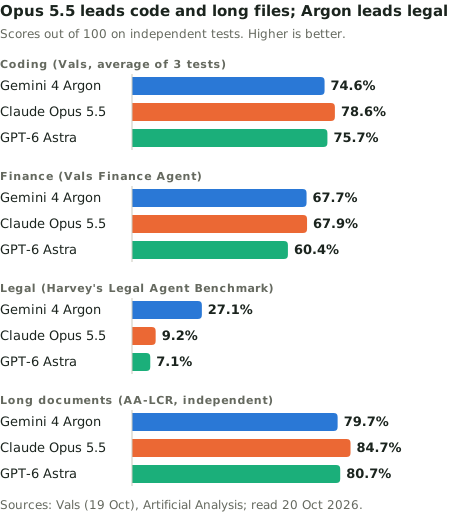
- Vals coding, the average of three coding tests: Opus 78.64, Astra 75.74, Argon 74.64. This is our average of Vals’s published scores.
- Terminal-Bench 4.0, which Vals describes as solving problems at the command line. On Vals, Opus scores 65.15%, Astra 59.60% and Argon 57.58%.
- Code Migration, porting a project to another programming language: Opus 80.49, Astra 78.03, Argon 74.43.
- CursorBench uses vague, multi-file tasks taken from real sessions in the Cursor code editor. At the same medium effort, the scores are almost equal: Argon 52.8%, Opus 52.5%. But Opus’s higher effort settings go further: 56.0% at High and 57.8% at Max. Argon peaks at 52.9% (CursorBench). Astra is not on Cursor’s list.
Argon wins one coding test. On Vibe Code Bench, where a model builds a whole app from start to finish, Argon scores 91.91, Opus 90.29 and Astra 89.59. Google’s own table also has Argon ahead on DeepSWE, a software-engineering test (77.9 vs 74.2), and behind on FrontierSWE (55.0 vs 62.3).
If you want the best coding score per dollar, look at Claude Sonnet 5.5 too. It costs half as much as Opus ($2 / $10) and tops Vals’s coding average at 81.30.
For long documents, Google’s test favours Argon and the independent test favours Opus
All three models can read about a million tokens at once (Argon 1,048,576, Opus 1M, Astra 1,050,000). That is roughly 750,000 words, the size of several long novels. Being able to read that much is not the same as reading it well, and the two tests that measure it disagree:
- Google’s test (GraphWalks): Argon beats Opus 5.5 at both lengths Google reports, up to 128K tokens and from 256K to 1M. At the longest length, Argon scores 84.2 and Opus 66.8. Google chose and ran this test.
- The independent test (AA-LCR): on Artificial Analysis’s long-context reasoning test, Opus 5.5 scores 84.7%, Astra 80.7% and Argon 79.7%.
If long files are your main job, test a few of your own before choosing.
Argon has one feature the other two lack: very long output. One request can write 64K tokens. A “long decode” mode chains those requests until the total reaches about 1M tokens of output (long decode docs). Opus 5.5 and Astra stop at 128K tokens of output, or 300K for Opus through Anthropic’s batch API.
Price differs for long prompts too. Argon and Opus charge the same per-token rate whatever the prompt size. Astra charges more once a prompt passes 272K tokens: double for input ($20 per million) and 1.5 times for output ($75 per million), applied to the whole request (OpenAI model page).
What one task costs: $0.32 on Argon today, $0.64 from 1 December, the same as Opus
What you pay depends on two things: the price per token, and how many tokens the model uses. Output tokens include the model’s hidden “thinking” before it answers, and some models think far more than others.
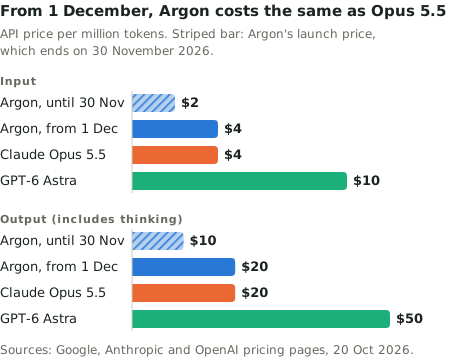
Start with list prices. Say you send a 150,000-token document (about 110,000 words) and get back a 2,000-token summary. Before counting any thinking:
| Today | From 1 December | |
|---|---|---|
| Gemini 4 Argon | $0.32 | $0.64 |
| Claude Opus 5.5 | $0.64 | $0.64 |
| GPT-6 Astra | $1.60 | $1.60 |
Make the document 500,000 tokens and Astra’s long-prompt rate applies. Argon costs $1.02 today and $2.04 from 1 December, Opus 5.5 costs $2.04, and Astra costs $10.15.
Now real tasks, where thinking counts. Independent testers ran the same jobs on all three and recorded the bill:
- Vals (finance, coding, legal and tax tasks), all at Argon’s December price: Argon $13.37 a test, Astra $21.28, Opus 5.5 $28.12. Argon costs about half as much as Opus at the same per-token price because it wrote far fewer tokens: about 146 million output tokens against about 500 million for Opus.
- Artificial Analysis (its 10 tests): Argon $1.99 a task at today’s price, which is $3.98 at the December price. Opus 5.5 costs $5.98 and Astra $3.26. Astra has the highest per-token price but writes the fewest tokens: 60 million, against 110 million for Argon and 260 million for Opus.
- CursorBench (coding) goes the other way. Argon costs $4.39 a task against Opus’s $2.91, at almost the same score. Cursor priced Argon at $2 / $10 at launch. If its table still uses that price, Argon’s cost here roughly doubles to $8.78 from 1 December. That is our estimate, not Cursor’s.
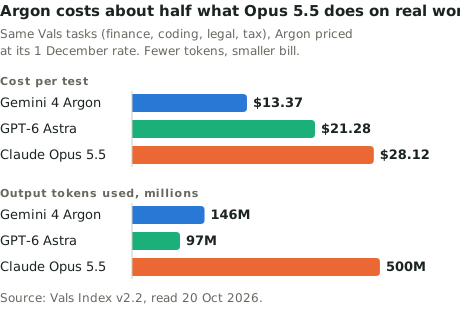
So Argon is the cheaper model for document and analysis work, and Opus 5.5 is the cheaper model for coding in Cursor. The only way to know your own cost is to run your own tasks.
Our verdict: Argon for legal work and cost, Opus 5.5 for code, Astra mostly if your plan already has it
This is our judgment from the numbers above, not a test we ran ourselves.
Students
If you are a US college student, take the free AI Pro year before 31 December 2026 and use Argon in the Gemini app. Everyone else pays about $20 a month for Argon or Opus 5.5: Google AI Pro at $19.99 or Claude Pro at $20. Astra in ChatGPT chat starts at $100 a month, which is hard to justify for coursework.
Developers
Use Opus 5.5 for serious coding. It wins Terminal-Bench, Code Migration and the higher-effort CursorBench runs, and on Cursor it costs less per task. Try Sonnet 5.5 too: it costs half as much and scores higher on Vals’s coding average. Try Argon for quickly building a web app from scratch, its one clear coding win, while the launch price lasts.
Analysts
For legal work, use Argon. On Harvey’s Legal Agent Benchmark, Argon ranks first of 23 models at 27.08%. Opus 5.5 scores 9.17% and Astra 7.08% (Vals HLAB). For finance, the quality is a tie: on Vals’s finance agent test, Opus scores 67.85 and Argon 67.66. Argon costs about half as much per test, so start with it. For long files, the evidence splits: Google’s test favours Argon and the independent test favours Opus.
Teams
Before you commit, run about 20 of your real tasks through Argon and Opus 5.5 and compare the quality and the bill. From 1 December the two cost the same per token. On Vals’s mixed office work, Argon used fewer tokens and came out at about half the cost. On Cursor’s coding work, it cost more. For office documents, Opus is stronger: on GDPval-AA, a test of real work tasks across 44 occupations, Opus scores 1866, Argon 1623 and Astra 1573. Choose Astra only if your team already pays for ChatGPT Business or Enterprise, where it comes with the plan. On these tests it trails Opus 5.5 everywhere, mostly sits level with or below Argon, and costs the most per token.
How we checked
We read every price, plan and score above on the original page on 20 October 2026: Google’s, Anthropic’s and OpenAI’s own pricing, model and help pages, plus Vals, Artificial Analysis and Cursor’s CursorBench. Google’s own benchmark table comes from the Argon model card, read on 14 October. We did not run the models ourselves for this post. Prices and rankings change often. Argon’s price changes on 1 December, and we will update this page after that.